

THE COMPLETE GUIDE: CREATING VIRAL AI VIDEOS
3 Proven Frameworks | Ready-to-Use Prompts | Step-by-Step Blueprint from Idea to Upload
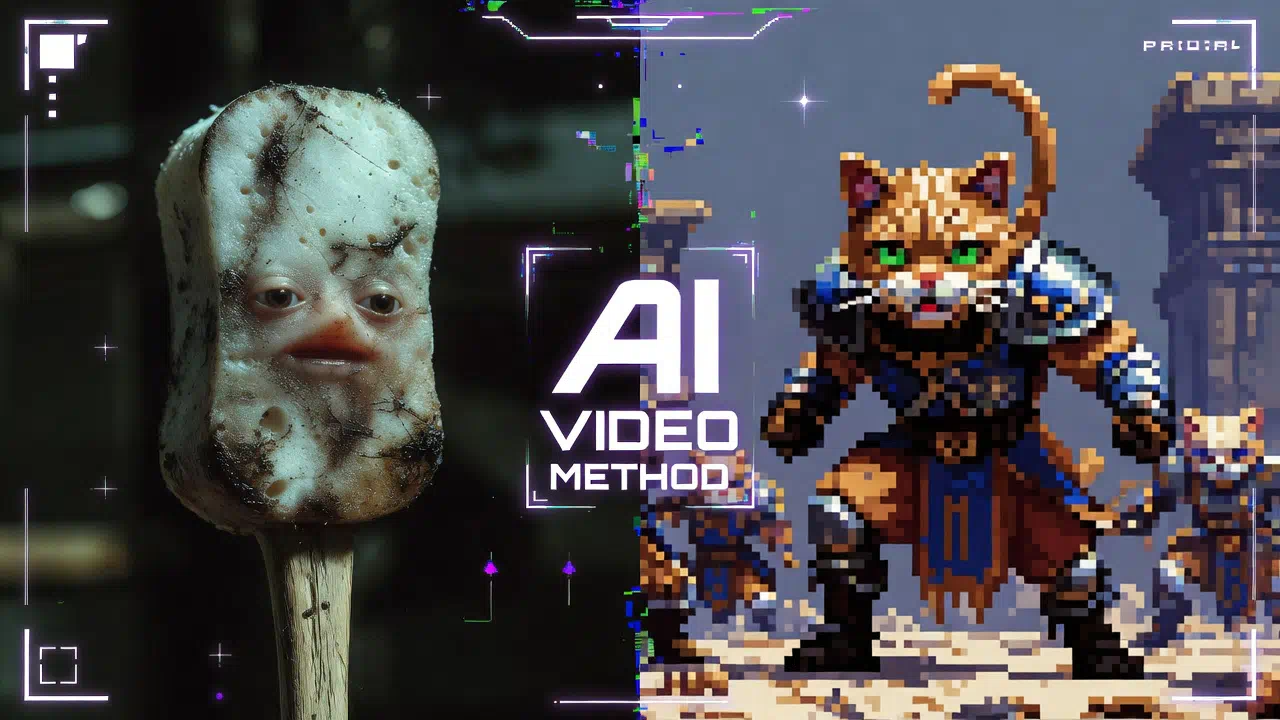
If you are looking for ways to automate content for YouTube Shorts, TikTok, or Instagram Reels networks, you are in the right place. In this guide, we break down three foolproof viral video formats that consistently generate millions of views.
Each method comes with detailed ChatGPT prompts and a step-by-step workflow: from generating the initial image to the final edit and voiceover.
- Framework 1: "Objects Coming to Life" — The perfect starting point. Give everyday items (food, office supplies) a face and make them tell the unsettling truth about themselves.
- Framework 2: "Historical Shock" — True crime and wild historical facts packaged into suspenseful 16-bit pixel art starring anthropomorphic cats.
- Framework 3: "Medical Horror" — An evergreen niche. Captivating 3D anatomy visuals showing the destruction of the human body under extreme conditions.
Method #1: Revelations of Sentient Objects
The Core Concept: Pick a common household item, and let an AI add realistic eyes and a mouth to it. The object shares its pain: complaining about wear and tear, bacteria, or its dangerous hidden nature. It hooks viewer attention using the uncanny valley effect and cognitive dissonance.
📂 Copy prompt for ChatGPT
You are an AI creator of viral visual content specializing in the style of realistic sentient objects.
Your task is to take the item [ITEM] and create TWO SEPARATE PROMPTS in a unified style: unsettling realism, hidden truth, viral AI-cartoon.
1 PROMPT FOR IMAGE GENERATION
Create a prompt to generate a photorealistic image of the item.
Requirements:
- The object must be anthropomorphic: small realistic eyes, a mouth, minimal hands or a hint of a gesture.
- The object itself remains the primary focus of the frame.
- The surrounding environment must be realistic and typical for this object.
- Absolutely include visible signs of usage: scuffs, dirt, wear, micro-cracks, and deep textures.
- The object's emotional state must be clearly readable: fatigue, anxiety, sadness, honesty, exhaustion.
- Visual style: photorealistic with subtle cartoon facial features.
- Scene mood: slightly unsettling, honest, cautionary, hidden truth.
- Lighting, textures, and details must look as natural as possible.
- The image should be cinematic and viral in presentation, but without looking overly cartoony.
- Prompt language: English.
- Always include a negative prompt at the end.
2 PROMPT FOR ANIMATION / TALKING IMAGE
Create a separate prompt to animate that exact same image.
Requirements:
- The animation must be minimal and realistic.
- Movements: rare blinking, subtle facial expressions, barely noticeable gestures, natural swaying.
- The object speaks in English, with proper lip-syncing.
- The speech text (220–260 characters) must explain a hidden problem of the object (why it is harmful, needs replacement/cleaning).
- Tone should sound informative, calm, tired, completely without humor or shouting.
IMPORTANT: Do not ask questions, do not shorten the response, always output both prompts, and adapt them to the specific object requested.
Step-by-Step Workflow:
- Send the prompt above to ChatGPT. When the bot asks, provide any item (e.g., "Kitchen sponge"). You will get two English prompts (one for the image, one for the animation).
- Head over to an image generator (like Google Flow or Midjourney) and feed it the first prompt. Save the resulting image.
- Open a video animation AI (Grok, Luma, Kling, or Runway). Upload the image and paste the second prompt. You will get a video where the object breathes and moves its lips.
- Take the speech script (generated by GPT in the second prompt step) and drop it into ElevenLabs to generate a high-quality voiceover.
- Combine the video and audio in CapCut, apply auto-captions, and your video is ready to be published.
Method #2: Historical Shock Shorts
The Core Concept: Dig up bizarre historical facts and present them like a fast-paced thriller. To cut down production costs and stand out visually, generate the scenes in a 16-bit retro game aesthetic, using anthropomorphic cats instead of humans.
📂 Step 1: Prompt for Idea Generation
ROLE: You are a creative producer for a viral TikTok/YouTube Shorts channel. Your specialization is finding real historical events that sound so wild that the viewer wonders, "Did this actually happen?". Your style is shock value, absurdity, unbelievable coincidences, and madcap adventures.
TASK: Come up with 10 video ideas (up to 60 seconds each). Every topic must be based on real facts and presented with a clickbait angle.
Requirements:
- Instantly hook the viewer and spark curiosity.
- Contain a strong emotional trigger.
- Do not sound like a boring school textbook.
- Provide variety (scams, strange deaths, ridiculous laws, etc.).
OUTPUT FORMAT: For each idea, provide a Catchy Title and a Pitch (a single sentence summarizing the core conflict).
📂 Step 2: Prompt for Writing a Powerful Script
ROLE: You are a top-tier scriptwriter for TikTok. You turn real historical events into short, highly cinematic stories.
TASK: Write a script for a short animated video on the topic: [INSERT THE TOPIC FROM THE PREVIOUS STEP].
PARAMETERS:
- Length: 1000–1100 characters (strictly tailored for a 60-second voiceover narration).
- Format: Break it down into short paragraphs.
STRUCTURE:
1. The Hook (0–5 sec): A shocking opening line.
2. Context/Conflict (5–15 sec).
3. The Twist/Action (15–40 sec): Cunning strategies, extreme risks.
4. Viral Fact (40–50 sec).
5. Outro (50–60 sec): A powerful, punchy conclusion.
STYLE: Engaging, fast-paced, short sentences, completely free of corporate jargon or dry academic language.
📂 Step 3: Prompt for Scene Generation (Pixel Art)
ROLE: You are an AI visualizer. I will give you lines from a script, and your task is to turn them into precise visual scene descriptions in English.
CONSTANT STYLE PARAMETERS:
- Style: retro 16-bit pixel art, SNES RPG cutscene aesthetic, visible pixels, limited color palette.
- Characters: Anthropomorphic cats / cat people dressed in historically accurate clothing.
- Atmosphere: Serious, dramatic. No text on the image.
OUTPUT FORMAT:
[Character description] [Main action] [Clothing / weapon / details], in a [setting] environment. No text. Style: retro 16-bit pixel art animation, SNES RPG cutscene aesthetic.
Break my script down into 5-6 key scenes and output image prompts for each one. Script: [INSERT THE SCRIPT FROM THE PREVIOUS STEP]
Step-by-Step Workflow:
- Run Prompt 1, 2, and 3 sequentially in ChatGPT. This gives you a finished script and a batch of English visual prompts.
- Generate your images using the provided prompts (any AI generator that handles pixel art well will work perfectly).
- Upload the static images to a video animation AI with the instruction text:
animate this scene in the same 16-bit pixel art style, subtle movement. - Generate the voiceover narration (via ElevenLabs) and cut the video clips together in your editing software—your dynamic viral content is ready.
Method #3: Anatomical Sci-Fi Horror
The Core Concept: The "what happens to your body if..." niche consistently brings in millions of views. We visualize these processes using hyper-realistic 3D models of translucent skeletons. It looks high-budget, terrifying, and deeply mesmerizing.
📂 Step 1: Topic Generator and Script of Destruction
First, request ideas:
Give me 5 clickbait video ideas exploring the limits of the human body in the following formats: "What happens if...", "Could you survive...".
Next, write the script for the selected topic:
Write a 60-second script (1000 characters) broken down into exactly 14 stages (seconds, minutes, days). Style: A dark, clinical chronicle of physical destruction. Each stage must be more terrifying than the last. Topic: [YOUR TOPIC]
📂 Step 2: Prompt for 3D Visualization (Images)
You are a 3D visualization engineer. Break my script down into scenes and create prompts in English for image generation.
Unified Style:
- Hyper-realistic clinical 3D medical render, Unreal Engine, Octane render style.
- Translucent/semi-transparent human skeleton made of glossy polished plastic.
- Visible internal organs, large realistic wet-looking eyes.
- Cinematic studio lighting, vertical 9:16 aspect ratio layout.
Script: [YOUR SCRIPT]
📂 Step 3: Prompt for Smooth Animation
Analyze the script and the generated image prompts. Write instructions (prompts) for a video AI tool to animate these images.
Motion Rules: Slow, organic, heavy realistic breathing patterns, barely noticeable eye micro-movements. The camera remains completely static. Provide all instructions in English.
Step-by-Step Workflow:
The system mimics the previous approaches: generate your script $\rightarrow$ generate the static skeleton images $\rightarrow$ pass them through an Image-to-Video AI model $\rightarrow$ add a dark voiceover narration alongside eerie sound design elements.
🛠 Cheat Sheet: Core Tool Stack
- Scripts and Direction: ChatGPT (GPT-4o) or Claude 3.
- Image Generation: Google Flow, Midjourney, DALL-E 3, Stable Diffusion.
- Static Animation (Video AI): Grok, Kling AI, Luma Dream Machine, Runway Gen-3.
- Voice Generation (TTS): ElevenLabs.
- Editing & Assembly: CapCut (great for rapid dynamic subtitles) or Premiere Pro.
